
Hip replacement surgery, or total hip arthroplasty, is one of the most well-established and successful procedures in modern orthopedic surgery. It aims to replace a damaged joint, most often affected by osteoarthritis (coxarthrosis), in order to restore mobility and eliminate debilitating pain. Thanks to advancements in materials and minimally invasive techniques, this hip surgery allows for a quick return to daily activities today.
However, such an intervention naturally raises questions:
- How long does a hip replacement operation take?
- What are the different techniques used?
- How does the recovery process unfold?
This guide provides precise answers to support patients throughout their care journey, from preparation for the operating room to resuming walking.
What is a total hip replacement?
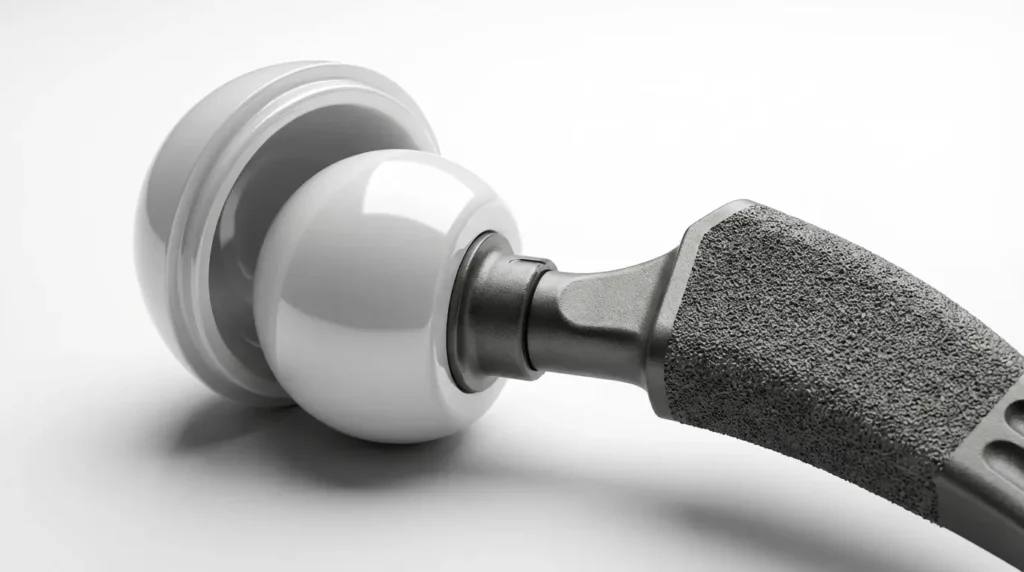
A total hip replacement (THR) is an internal joint device designed to replace the worn surfaces of the natural joint. It consists of several mechanical components that closely replicate the anatomy: a stem inserted into the femur, a spherical head (the ball), and a cup fixed in the pelvis (the acetabulum). The articulation between the ball and the cup restores smooth mobility, eliminating the painful bone-on-bone friction.
Composition and function of the implant: the friction couple
The choice of materials is a determining factor in the success of hip surgery. The interaction between the two materials that slide against each other is called the "friction couple." Today, surgeons favor biocompatible and extremely resistant materials to minimize wear.
Ceramic-on-ceramic bearings are very frequently used because they offer minimal friction and optimal longevity, making them particularly suitable for active patients. Another common option is ceramic-on-polyethylene (a high-tech plastic) bearings: this combination is valued for its robustness and shock absorption.
The different types of fixings: cemented or cementless
There are two main ways to secure the prosthesis to the patient's bone:
- Cementless fixing (Press-fit): The implant has a porous surface, often coated with hydroxyapatite (a natural component of bone), which allows bone to regrow directly in contact with the metal. This technique is preferred when bone quality is satisfactory.
- Cemented fixing: The surgeon uses a surgical polymer (bone cement) to fix the components. This method ensures immediate stability and is often more suitable for patients with osteoporosis or more fragile bones.
Why is hip replacement surgery necessary?
The decision to undergo hip surgery is never taken lightly. It generally occurs when conventional medical treatments (pain relievers, anti-inflammatories, injections, or physical therapy) are no longer sufficient to relieve the patient's pain. The primary objective is to restore a quality of life that has become inadequate due to joint deterioration.
Hip osteoarthritis and the causes of joint degeneration
The most common cause leading to hip replacement surgery is osteoarthritis of the hip (coxarthrosis). This is a chronic wear and tear of the cartilage that covers the head of the femur and the hip socket. Once the cartilage thins or disappears, the bones rub directly against each other, causing sharp pain and increasing stiffness.
Other medical conditions may also justify this hip surgery:
- Osteonecrosis of the femoral head: Part of the bone dies due to a lack of blood supply.
- The hip dysplasia : a congenital malformation that causes premature wear and tear of the joint.
- The congenital hip dislocation : a birth defect which, if not treated early, leads to early and severe osteoarthritis.
- The after-effects of trauma: A fracture of the femoral neck can degrade the joint in the long term.
Symptoms that indicate the need for hip surgery
Several clinical signs indicate the progression of the condition and the need for intervention. The first is pain, often located in the groin crease, but which can radiate to the buttock or knee. This pain becomes bothersome in daily life: it limits walking distance and can even occur at rest or during the night.
Loss of mobility is the second major indicator. Patients report increasing difficulty performing simple tasks, such as putting on socks, tying shoelaces, or getting into a car. When these limitations impact independence and functional impairment becomes a daily occurrence, hip replacement surgery is then seriously considered to regain a normal life.
The hip surgery procedure: from preparation to the operating room
The success of a hip replacement operation depends on rigorous planning and precise technical execution. Every step, from the pre-operative consultation to the final stitches, is designed to ensure patient safety and the long-term viability of the implant.
Pre-operative preparation and complete medical assessment
Before confirming the date of the procedure, a thorough health assessment is carried out. This assessment helps identify and address any potential risk factors. It generally includes a complete blood test and a cardiac evaluation performed by a cardiologist.
A crucial aspect of this preparation is identifying any sources of infection. A visit to the dentist is essential to check for any dental infection, as is a urine test: any bacteria circulating in the blood could attach to the new prosthesis. Finally, a consultation with the anesthesiologist allows for the selection of the most appropriate type of anesthesia: general or epidural (spinal).
How long does a hip replacement operation take?
This is a common question during consultations. On average, a hip replacement operation takes between 60 and 90 minutes. This duration can vary slightly depending on the complexity of the patient's anatomy or the surgical technique used.
However, a distinction must be made between the actual surgical time and the total time spent in the operating room. Including preparation, anesthesia, and immediate recovery, the patient generally remains in the operating room for approximately two to three hours before being transferred to the post-operative recovery room.
Surgical techniques: minimally invasive anterior approach and posterior approach
The surgeon can access the joint through different routes, called "approach routes":
- The minimally invasive anterior approach: This technique is increasingly preferred. It involves passing between the muscles without ever cutting them. By preserving muscle and nerve integrity, it reduces post-operative pain, limits the risk of limping, and allows for an almost immediate return to walking.
- The posterior route: This is the most classic and widely used technique worldwide. It offers excellent visibility of the joint. Although it requires cutting small rotator muscles (which are carefully sutured at the end of the procedure), modern protocols now allow for a very rapid recovery, similar to that of the anterior approach.
The choice of technique depends on the surgeon's experience, the patient's morphology, and the specific characteristics of their hip.
Recovery after hip replacement surgery
The period following the procedure is just as important as the surgery itself. Today, advances in care protocols allow for a much faster recovery than in the past, transforming the patient experience.
Hospitalization and the Enhanced Recovery After Surgery (ERAS) protocol
The length of hospital stays has been significantly reduced. Thanks to the ERAS (Enhanced Recovery After Surgery) protocol, many patients can return home after only one or two nights in the hospital. In certain specific cases, the procedure can even be performed on an outpatient basis, with patients returning home the same day.
This protocol is based on a multidisciplinary approach aimed at minimizing stress on the body. It includes modern pain management (multimodal analgesia) which avoids the side effects of harsh treatments and promotes a revitalized awakening. The central element of enhanced recovery after surgery (ERAS) is early mobilization: on the evening of hip surgery, with the help of healthcare professionals, the patient gets up for the first time and sometimes takes their first steps.
Rehabilitation: exercises and timeframes for walking normally
Rehabilitation begins immediately. It doesn't necessarily have to be intense, but it must be regular. The first steps are taken with the aid of crutches to ensure balance and partially relieve pressure on the joint during the tissue healing phase.
The rehabilitation program includes:
- Muscle awakening exercises (quadriceps, glutes).
- Gentle bending movements to regain flexibility.
- Work on the quality of gait to avoid limping.
Progress is often rapid: patients typically abandon one cane around the third week, and then the second one towards the end of the first month. The goal is to regain a smooth, unassisted gait between 4 and 6 weeks after the procedure.
When can I get back behind the wheel after the procedure?
Resuming driving requires sufficient recovery of muscle strength and reflexes, particularly for the ability to perform emergency braking without hesitation. Generally, driving is permitted between 4 and 6 weeks after hip replacement surgery.
This waiting period may be slightly shorter for patients with an automatic vehicle if the operation involved the left leg. In all cases, it is essential to wait for the surgeon's approval at the first follow-up appointment before driving again.
Risks, complications and medical follow-up
Like any major surgical procedure, hip replacement surgery carries risks. Although the complication rate is statistically low (approximately 1 to 3), it is essential to be aware of these risks in order to better prevent and detect them.
Possible complications: infection, dislocation and fracture
Complications can occur immediately after the operation or in the weeks that follow:
- The infection: This is the most feared complication. It can affect the scar or, more seriously, the joint itself. To prevent it, antibiotics are routinely administered during the procedure and strict hygiene is enforced.
- Dislocation: The prosthesis head can protrude from its socket. This risk has been significantly reduced thanks to the use of larger diameter femoral heads and improved surgical approaches. The safety instructions given by the physiotherapist during the first few weeks are specifically designed to prevent this risk.
- Thromboembolic complications: The formation of a blood clot in the veins (phlebitis) can lead to a pulmonary embolism. Prevention relies on early mobilization, wearing compression stockings, and administering anticoagulant treatment for a few weeks.
- Intraoperative fracture: At the time of implantation, the bone may crack. The surgeon then stabilizes the area immediately, often using steel wires (cerculation).
Long-term monitoring: detecting wear or loosening
Once the healing period is over, regular follow-up is necessary to ensure the implant functions properly over time. A check-up appointment with an X-ray is generally scheduled at one year, then every two to three years.
This monitoring allows us to track two major phenomena:
- Wear and tear: Over time, friction components can wear out. New materials (ceramic-ceramic) have significantly reduced this problem.
- The unsealing: This involves a loss of fixation of the prosthesis in the bone. It often manifests as a return of pain, initially during walking.
Detecting these signs early sometimes allows for simplified maintenance before the bone becomes too damaged. If significant deterioration is observed after several years, a hip replacement revision can be programmed to replace worn components.
Living with a prosthesis: results and lifespan

The ultimate goal of hip replacement surgery is to allow the patient to forget about their joint. In our jargon, we call this a "forgotten hip": a joint so natural and painless that it is completely unnoticeable in daily life.
Expected results on pain and mobility
The results of this surgery are among the best in all of orthopedic practice. In more than 95% of cases, osteoarthritis-related pain disappears almost completely within the first few weeks. Morning stiffness and pain during the first few steps (the "loosening up" pain) quickly subside.
Functionally, the patient regains a smooth gait and the ability to go up and down stairs without fear. The recovery of mobility allows them to resume simple but essential movements, such as squatting or crossing their legs, thus restoring complete independence.
What is the lifespan of a hip replacement?
Thanks to technological innovations in materials and bearing surfaces, the lifespan of implants has increased considerably. It is now estimated that more than 90% of % prostheses are still functional 20 years after implantation. For the most recent models, particularly those with ceramic bearing surfaces, this lifespan can exceed 25 or even 30 years.
Several factors influence this longevity:
- The patient's physical activity: moderate activity is beneficial, while extreme exertion can accelerate wear and tear.
- Weight: maintaining a suitable weight limits mechanical stress on the implant.
- Bone quality: good bone density promotes long-term fixation stability.
Resuming sports and daily activities after the break
Having a hip replacement doesn't mean the end of sports activities. On the contrary, movement is beneficial for maintaining muscle strength and bone quality around the implant. However, resuming activity must be gradual and tailored to your needs.
Low-impact sports are highly recommended: swimming, cycling, Nordic walking, and golf are examples. More demanding sports such as tennis, skiing, or mountain hiking are perfectly acceptable if the patient was already practicing them before the operation, ideally after six months.
On the other hand, high-impact sports (running on hard surfaces, combat sports or team contact sports) are generally discouraged because they involve repeated shocks that could reduce the lifespan of the prosthesis.
Frequently Asked Questions
Is it possible to have sexual relations after a hip replacement?
Resuming sexual activity is generally possible about 6 to 8 weeks after hip surgery. This timeframe allows the tissues surrounding the prosthesis to heal sufficiently to ensure joint stability. During the first few weeks of resuming sexual activity, it is advisable to favor comfortable positions that do not require extreme flexion or rotation of the hip. Listening to your body's signals remains the best guide.
What position should I adopt for sleeping after the procedure?
Sleep may be disrupted for the first few nights. The ideal sleeping position is on your back, which ensures perfect stability of the prosthesis. If you prefer to sleep on your side, it is recommended that you lie on your non-operated side with a thick pillow between your legs: this prevents the operated leg from bending inward (adduction), thus reducing the risk of dislocation. Sleeping on your operated side is possible as soon as the scar is no longer sensitive, often after a month.
How to travel with a prosthesis (gates, long journeys)?
The materials used (titanium, cobalt-chromium) can trigger airport security scanners. It is therefore advisable to travel with a medical certificate or your surgical report, although security personnel are now quite accustomed to this situation. For long journeys by plane or car, the main risk is deep vein thrombosis (phlebitis). It is recommended to wear compression stockings, stay well hydrated, and move around regularly: take a few steps in the aisle of the plane or plan frequent stops in the car to walk for five minutes.
Is it normal to experience a leg length discrepancy?
Occasionally, some patients experience a sensation of "legs being too long" immediately after surgery. In the vast majority of cases, this is a false impression related to muscle contractions caused by years of adaptation to osteoarthritis. With rehabilitation and tissue loosening, this sensation usually disappears within a few months. The surgeon always checks the leg length during the procedure, but the priority remains the stability of the prosthesis and optimal muscle tension to prevent dislocation. Between length and stability, stability is the preferred choice.
What are the signs that should prompt a consultation?
Even though the after-effects are usually straightforward, certain signs should prompt you to contact your surgeon or doctor quickly:
- An unexplained fever or chills.
- A scar that becomes red, hot, painful, or that has a discharge.
- A sharp, brutal pain that does not subside with rest.
- Significant and painful swelling of the calf (a possible sign of phlebitis).
Ready to regain a smooth, pain-free gait?
The information presented in this guide on the procedure and recovery protocols is an essential first step in your decision-making process. However, the success of a hip replacement depends on a tailored surgical strategy: the choice of technique, implant type, and rehabilitation program must be strictly adapted to your anatomy and life goals.
If you wish to obtain an accurate diagnosis or specific answers regarding your suitability for minimally invasive surgery, a dedicated consultation will allow your case to be studied in depth.
You can book an appointment directly on the page Contact. We will assess your situation together to define the care plan that will allow you to regain your autonomy in a lasting way.




 English
  French