HIP SURGERY

Hip replacement

In the event of wear or following a complication, a hip prosthesis may require revision surgery. 
The aim of this operation, which is more complex than a first-line operation, is to fit a new prosthesis that is stable and can restore joint anatomy (the biomechanics of the hip joint). 
Reconstruction can also be carried out if the bone damage is extensive.

Hip replacement surgery requires specific know-how and experience. The surgeon must master several surgical techniques in his "therapeutic armoury" to be able to deal with the different situations encountered. Not all hip replacements are the same, and no single surgical technique can be used to deal with every situation.

picto hip 2

Why replace a hip prosthesis?

There are several situations in which it may be necessary to replace a prosthesis:

  • Loosening of the prosthesis Loosening of the prosthesis: in general, loosening is the result of wear on the prosthesis. However, loosening can also be the result of a problem with implant fixation. The implant then becomes abnormally mobile in relation to the bone. This may be the femoral part or the acetabulum of the prosthesis, which starts to move and shift. It is this loss of adhesion between the prosthesis and the bone that causes the pain. 
  • Recurrent dislocation Dislocation of the prosthesis: this is instability of the prosthesis. Dislocation of the prosthesis may be the result of wear or loosening of the prosthesis. It may also be due to an anomaly in the positioning of the implants. 
  • Infection In case of infection of the prosthesis, it may be necessary to change the whole prosthesis. Simply cleaning the prosthetic joint with a course of antibiotics is not always enough. 
  • Natural wear and tear Wear and tear: this is the consequence of the degradation of materials over time. Wear used to be much greater with first-generation prostheses. Today, we have ceramic-ceramic or highly cross-linked polyethylene friction couples that have extremely low wear rates.

Faced with these problems, revision surgery will restore hip function.

Nevertheless, the post-operative period following a revision hip replacement is often much longer than that following a first intention prosthesis.

hip replacement
irm

How do you prepare for a repeat operation?

The revision of a hip prosthesis is a more complex operation that requires planning and preparation:

  • An in-depth clinical assessment with the surgeon and anaesthetist.
  • A complete and appropriate additional imaging work-up (CT scan, MRI, scintigraphy): a radiographic work-up is often supplemented by a CT scan, and sometimes by an MRI. This imaging work-up enables the displacement of the prosthesis, its wear and tear, and any bone damage to the pelvis and femur to be assessed.
  • Biological work-up if infection is suspected: the joint is usually punctured to analyse the fluid for bacteria. A blood count and CRP are taken. 
  • A cardiological opinion is sought. It is sometimes necessary to complete this assessment with more specific tests (scintigraphy, cardiac echography, etc.).

As each case is unique, the surgeon will adapt the surgical strategy to your situation.

Prosthesis revision techniques

Depending on the condition of the prosthesis and the bone, different techniques can be used:

  • Partial or total replacement of the prosthesis
  • Bone reconstruction is sometimes necessary. This involves reconstituting the joint anatomy in the event of bone loss. It is often carried out using allografts, bone substitutes, etc. 
  • A support frame can be used to support the graft and the prosthetic cup. 
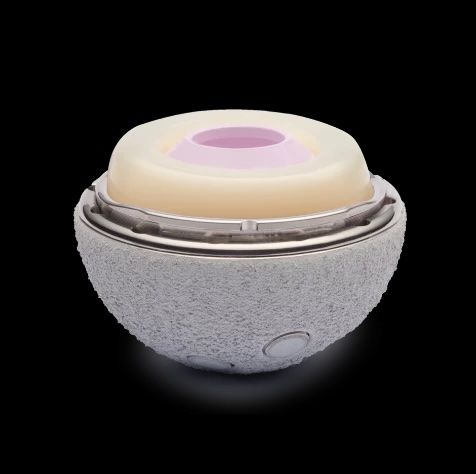
  • A custom-made reconstruction acetabulum can be manufactured upstream using a 3D reconstruction scanner. These custom-made implants offer an interesting solution in certain situations. 
  • As regards the approach to the joint, a revision hip replacement can be performed via an anterior, posterior or trans-trochanteric approach.
    • The anterior approach: we use this approach in the simplest revision operations, especially when only the acetabulum (i.e. the pelvic part of the prosthesis) needs to be changed. Post-operative recovery is faster. This is a favourable situation.
    • The posterior approach: we use this approach when the patient has already undergone posterior surgery, or when the entire prosthesis needs to be replaced and the reconstruction required is not too complex.
    • The trans-trochanteric approach: we use this approach in the most difficult cases, when the entire prosthesis has to be changed and extensive reconstruction is required.

Our teams use the latest innovations in materials and surgical techniques to achieve the best possible results.

dm sailhan cup
hip rehabilitation

Post-resumption recovery and rehabilitation

A hip replacement involves a longer period of rehabilitation and recovery:

  • Progressive mobilisation supervised by a physiotherapist
  • Personalised post-operative instructions 
  • Support instructions and a timeframe for full recovery adapted to each situation.
  • The surgeon may prescribe physiotherapy and muscle reinforcement at a later date.
  • The initial hospital stay is often slightly longer than after a first-line prosthesis.

Good patient involvement (compliance with the instructions given by the surgeon) is essential to ensure the success of the operation.

Where to have an operation in Paris?

Our teams work in a number of leading establishments in Paris:

For consultations:

  • Espace Médical Vauban
  • IMSS - Institut Médical Sport Santé
  • ARAGO Clinic

For interventions:

  • ARAGO Clinic

You will be cared for by recognised specialists: Dr Kerboull, Dr Sailhan and Dr Zilber, experts in hip surgery.

clinical entrance

The revision of a hip prosthesis is a specialised operation that restores joint stability and comfort.. Our expert teams in Paris are on hand to support you at every stage of your treatment.

Frequently asked questions (FAQ)

When should a hip replacement be considered?

In the event of pain, instability or radiological signs of wear or loosening.

Is the revision more complicated than a first prosthesis?

It is often more technical and more complex. The after-effects may be longer than after a first prosthesis. 

How long does a revised prosthesis last?

Around 15 to 20 years, depending on the case. The most recent materials have made it possible to increase the lifespan of these implants.